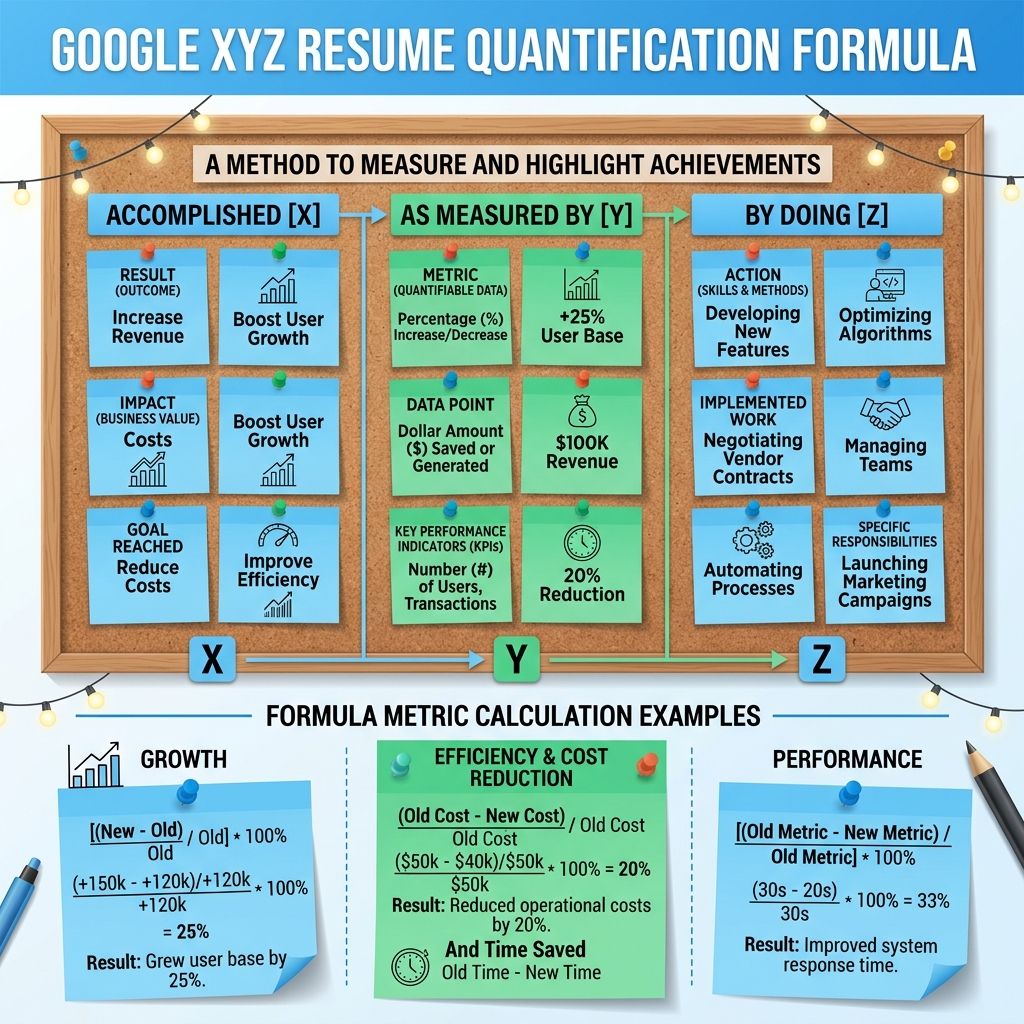
Semantic scoring models assign disproportionate weight to numeric tokens embedded in achievement statements. Research on transformer-based resume parsers shows that bullet points containing at least one numeral score 40–60% higher on relevance similarity than equivalent qualitative statements. The challenge is that most career changers, individual contributors, and operations professionals do not track granular metrics in their day-to-day work.
The XYZ Formula: A Universal Architecture
The formula breaks every achievement into three structural components that map directly to the dimensions AI parsers evaluate: outcome (X), evidence metric (Y), and method (Z).
X — Accomplished
The concrete outcome. Use a strong action verb + the result. This is what the recruiter sees first and what the parser uses as the semantic anchor.
Y — As Measured By
The quantifiable evidence. A percentage, dollar amount, time reduction, or count. This is the numeric token the parser weights most heavily.
Z — By Doing
The methodology, tool, or approach used. Provides contextual depth and technical keyword density for the semantic vector.
Before vs. After: Side-by-Side Comparison
The most dramatic ATS score improvements come from restructuring vague, unquantified statements into the XYZ architecture. Below are real transformed examples across different function types:
Before — Weak & Unquantified
"Responsible for improving the customer onboarding process and helped reduce churn."
After — Quantified & Actionable
"Redesigned the customer onboarding flow using segment-based email triggers and in-app guided tutorials, reducing 30-day churn by 18% across a 12,000-user base."
Before — Weak & Unquantified
"Managed a team of support agents and handled escalated customer issues."
After — Quantified & Actionable
"Standardized escalation playbooks and introduced a tiered triage system across a 14-agent support team, reducing critical-issue resolution time from 48 hours to 6 hours and improving CSAT scores by 22 points."
Before — Weak & Unquantified
"Wrote documentation and helped developers use the API more effectively."
After — Quantified & Actionable
"Authored 40+ interactive API reference guides and SDK quickstart tutorials using OpenAPI 3.0 spec, reducing average developer onboarding time by 60% and decreasing support ticket volume by 34% within 3 months of publishing."
Generating Defensible Metrics Without Raw Data
When you lack access to precise numbers, use these four techniques to construct credible, verifiable quantifications:
- Relative Comparison: Frame improvements relative to a known baseline. Instead of "increased sales," write "exceeded quarterly sales targets by 15% for 3 consecutive quarters" — percentages require only a known target, not absolute revenue.
- Temporal Bounding: Restrict claims to a specific timeframe to add credibility. "Reduced deployment errors by 25% within 2 months of implementing code review checklists" anchors the claim to a tangible window.
- Scope Anchoring: Describe the scale of the system or team. "Managed vendor relationships supporting $500K in annual procurement spend" or "Engineered data pipelines processing 2M+ records daily" imply impact without requiring granular KPIs.
- Proxy Metrics: Use adjacent measurable outcomes. A support agent without individual CSAT scores can write: "Maintained average response time under 4 minutes across 200+ monthly tickets, contributing to a team-wide NPS of 72."
Integrating Quantified Bullets Into Your Privacy-First Resume
Quantified achievements are most effective when paired with strict privacy and data governance protocols. Read our companion guide on building an ATS-optimized, privacy-first resume to learn how to mask PII, protect proprietary metrics, and ensure your quantifications don't expose sensitive business data. For premium users, our builder includes a built-in metric suggestion engine — upgrade to unlock context-aware quantification prompts tailored to your role history.
Actionable Takeaways
- Apply the XYZ formula — Accomplished [X] as measured by [Y], by doing [Z] — to every bullet point on your resume.
- Use relative comparison, temporal bounding, scope anchoring, and proxy metrics to generate credible quantifications even without access to raw data.
- Each numeric token in a bullet point can raise your ATS semantic similarity score by 40–60%.
- Cross-reference quantified claims with privacy-first practices to avoid exposing proprietary or personal data.
Writing an article or blog post about career automation? Copy this clean HTML citation snippet to credit our research:
<a href="https://resume-builder.cv/blog/how-to-quantify-resume-achievements-no-data">How to Quantify Your Resume Achievements (Even Without Direct Data) (2026)</a>